New work differs from more jobs in existing occupations because it requires novel, scarce expertise, and therefore pays higher wages. By making human expertise more valuable, new work is a key force offsetting the effects of automation.
New work – novel job tasks that demand human labor – is a significant component of total employment. Between 2011-2023, 18% of US workers were employed in jobs introduced since 1970.
In a new paper, forthcoming in the Annual Review of Economics, David Autor, Caroline Chin, Anna Salomons, and Bryan Seegmiller show that this new work differs systematically from more jobs in existing work.
Understanding the drivers and characteristics of new work is important in an era of increasing automation. Since the early 2000s, the “labor share” – the share of a country’s national income that goes to workers, rather than to owners of machines and capital – has declined 10% in the US. A similar pattern holds in many industrialized countries. New work helps counteract the effects of automation, which displaces workers and reduces the labor share.
The researchers use granular data from the linked US Census of Populations from 1940 and 1950 and the American Community Survey (ACS) for 2011 through 2023, including write-in responses from individuals who report their occupations. These data allow them to analyze the characteristics of new work over time, and who is employed in this new work.
Finding #1: Workers in new work are younger and more educated
Who performs new work? Younger and more educated workers are more likely to hold new job titles. This may be because it is easier for these workers to obtain the new skills and expertise needed in new work.
Across time periods, workers below age 30 are the most likely to be employed in new work, followed by workers ages 30-54. Workers ages 55-64 are the least likely to be employed in new work.
More educated workers are consistently more likely to be employed in new work, both overall and within occupational categories. Between 2011-2023, workers with advanced degrees were 2.9 percentage points more likely to be employed in new work than high school graduates.
The types of new work that have emerged recently differ from those that emerged several decades ago. In 1950, a large portion of new work was in production, clerical, and administrative occupations. In 2011-2023, the largest share of new work was in professional and managerial occupations.
Figure 1: Distribution of New Work by Broad Occupation
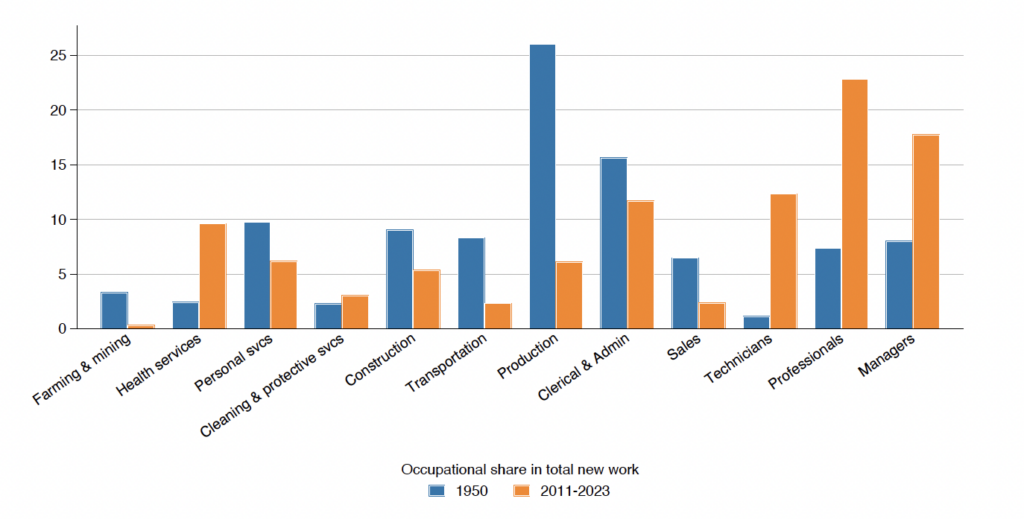
This figure compares the distribution of new work between types of occupations across two time periods. Occupations are ordered (from left to right) from lowest to highest paying. The blue bars correspond to new work emerging between 1930 and 1950, measured using 1950 Census Complete Count data. The orange bars correspond to new work emerging from 1970 to 2018, measured using the American Community Survey (ACS) over 2011 and 2014-2023. The bars indicate the share of total employment in new work for each occupation type. For instance, the farthest left bar shows that employment in new work in “Farming and Mining” occupations comprised 3.3% of total employment in new work in 1950. The figure shows that new work has shifted toward higher-paying occupations between the two time periods. (Source: Figure 1A, Autor et al. 2026)
These professional and managerial positions are more likely to be held by workers with a college degree. In recent years, new work for workers without a college degree is more likely to be in health services and personal services. These jobs tend to be lower-paying and less specialized than earlier work in production, clerical, and administration occupations.
Workers in new work in 1940 were disproportionately likely to be employed in new work in 1950, including in different new work. This suggests that workers gain specialized expertise and skills in new work that continue to be valuable in the labor market.
Finding #2: Workers earn higher wages in new work, reflecting the value of their scarce, specialized expertise
Across time periods, workers in new work earn a “wage premium” – higher wages than workers with similar characteristics in existing occupations. The wage premium is higher for “newer” new work and declines over time.
These findings suggest that new work requires valuable expertise (capability, skills, human capital, and/or know-how). They also indicate that the wage premium for new work reflects temporary scarcity in the skills required, rather than being a permanent feature of new occupations. As more workers gain these skills and the expertise becomes less scarce over time, the wage premium declines. The novel human expertise that new work requires fundamentally distinguishes new work from pre-existing work.
Figure 2: New Work Wage Premium by Vintage, 2011-2023
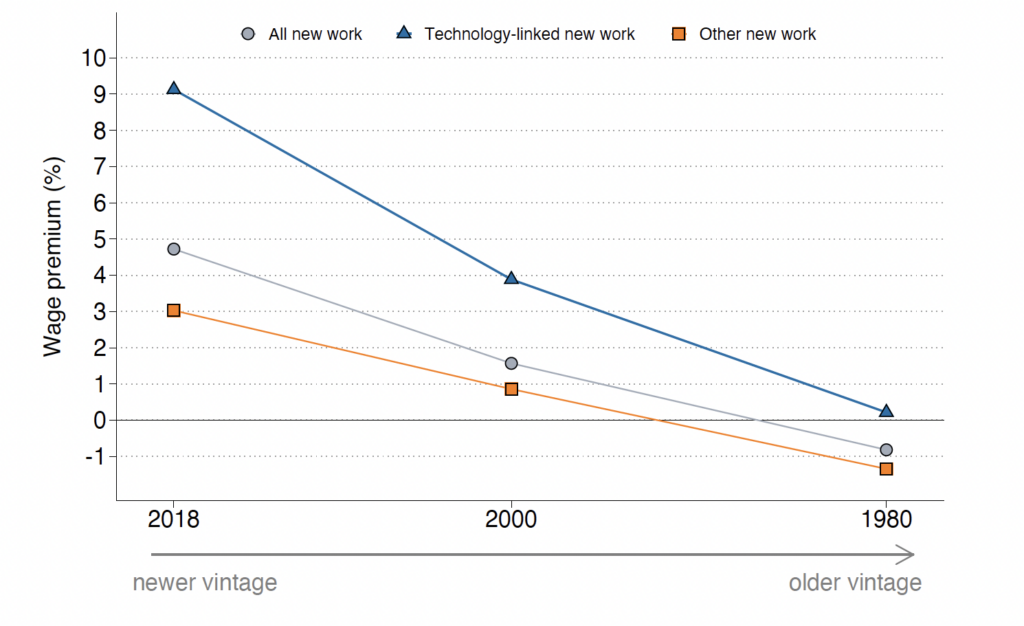
This figure shows how the wage premium for new work differs based on how “new” the new work is (relative to jobs that existed as of 1970), and whether the new work is linked to technology. The figure shows that “newer” new work commands a higher wage premium. It also shows that technology-linked new work has a higher wage premium than other new work in each time period, and particularly in the “newest” new work. On the x-axis is the “vintage” of new work: “2018” includes job titles introduced between 2000 and 2018; “2000” includes job titles introduced between 1980 and 2000; and “1980” includes job titles introduced between 1970 and 1980. Note that the x-axis runs from most recent to oldest vintage, left to right. On the y-axis is the estimated wage premium in log points, which approximate percentage differences in wages. Each data point represents the wage premium of being employed in a job introduced in each period relative to jobs that existed as of 1970, controlling for occupation, industry, geographic, and demographic characteristics. The blue triangles represent the wage premium for workers employed in new work linked to technology, while the orange squares represent the wage premium for workers employed in other (non-technology-linked) new work, and the grey circles represent the wage premium for workers employed in all categories of new work. (Source: Figure 2, Autor et al. 2026)
The wage premium is four times larger for new work associated with technological change than for other types of new work. Other types of new work generally reflect changing tastes, income levels, and demographics – for example, the new job titles of “mental health aide” in 1970 and “conference planner” in 1990. The technology-linked wage premium is also more persistent over time. This likely reflects the fact that new work associated with technology often requires more specialized and scarcer expertise.
Finding #3: Public policy can drive the emergence of new work
Other research has shown how technological change and demand shifts can drive the creation of new work. This new research offers a novel example in which public policy seems to have directly contributed to the emergence of new work.
In the 1940s, the US government commissioned large manufacturing plants for production during World War II. Garin and Rothbaum (2025) show that these investments led to increased employment and earnings for men born in the counties where plants were built, primarily by bringing more high-wage, blue-collar jobs to these locations.
Autor and co-authors find that locations where plants were built generated not only more work, but more new work. The share of employment in new work was 0.35 percentage points higher in 1950 in counties where plants were built, compared to other counties with similar characteristics. The difference was roughly twice as large in the manufacturing sector. Workers living in these counties in 1940 were more likely to be employed in new work in 1950.
There was no difference in the prevalence of new work between the same places in 1940, suggesting that the policy had a causal effect. The construction of plants during WWII seems to have helped propel local workers into higher-paying, more expertise-intensive work.
Conceptual schematic: New work, expertise scarcity, and wage premia
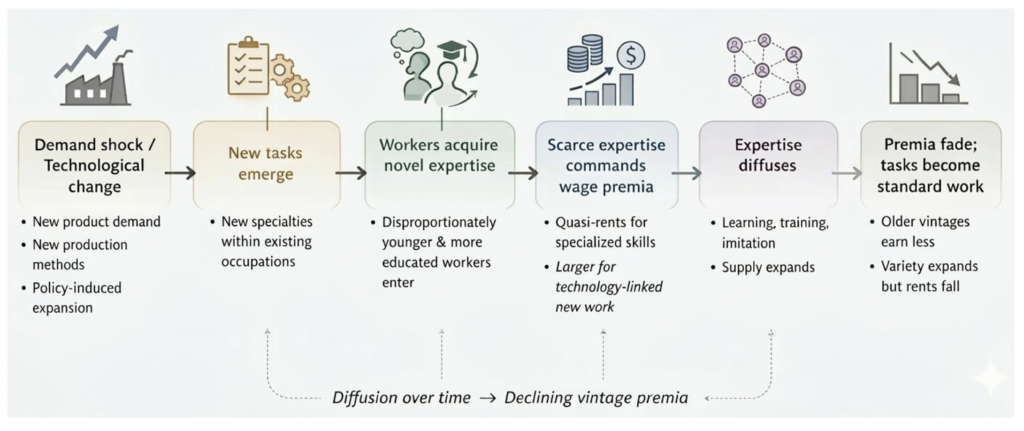
This schematic shows the flow of new work over time. Economic conditions (such as technological change, new consumer demand, or public policy) create new work; workers enter new work and gain novel, scarce expertise, which commands a wage premium; this expertise becomes less scarce as it spreads across the workforce; and the wage premium fades over time. (Source: Autor et al. 2026)
Conclusion: New work counteracts the job-displacing effects of automation
Not only does new work create new tasks for workers, but it also generates new demand for scarce human expertise. Because this expertise is scarce, workers performing new work command a wage premium. Though new work emerges from many sources, the United States post-WWII history demonstrates that public policy can drive the emergence of new work. New work is ultimately a central mechanism for maintaining and extending the value of human expertise in the face of automation.
Source: David Autor, Caroline Chin, Anna M. Salomons, and Bryan Seegmiller, “What Makes New Work Different from More Work?,” NBER Working Paper 34986 (2026), https://doi.org/10.3386/w34986.