Many experts predict that declining birth rates across the globe will hamper economic growth. However, new research finds this has not been the case over the past 70 years. Firms develop and adopt labor-saving technology in response to an aging, shrinking workforce, which increases productivity per worker and average earnings.
Over the past seven decades, birth rates have fallen substantially worldwide, fueling widespread concern among economists and policymakers that these declines will slow economic growth. In a new paper, Daron Acemoglu, David Autor, Keelan Beirne, and Andrew Scott study the effects of these past demographic changes on economic performance, comparing across countries and within the US.1 Contrary to standard economic models, they find that lower birth rates have actually raised GDP per working-age adult, with no negative impacts on aggregate GDP or earnings.
Birth rates have fallen substantially worldwide
In 1950, there were 3.78 births each year for every 100 people globally. By 2025, this number had more than halved to 1.71. As Figure 1 shows, birth rates declined both in industrialized countries and across the developing world. The United Nations projects that by the second half of this century, the global population will see its first sustained decline since the bubonic plague of the 1300s.
Figure 1: Global Trends in Birth Rates
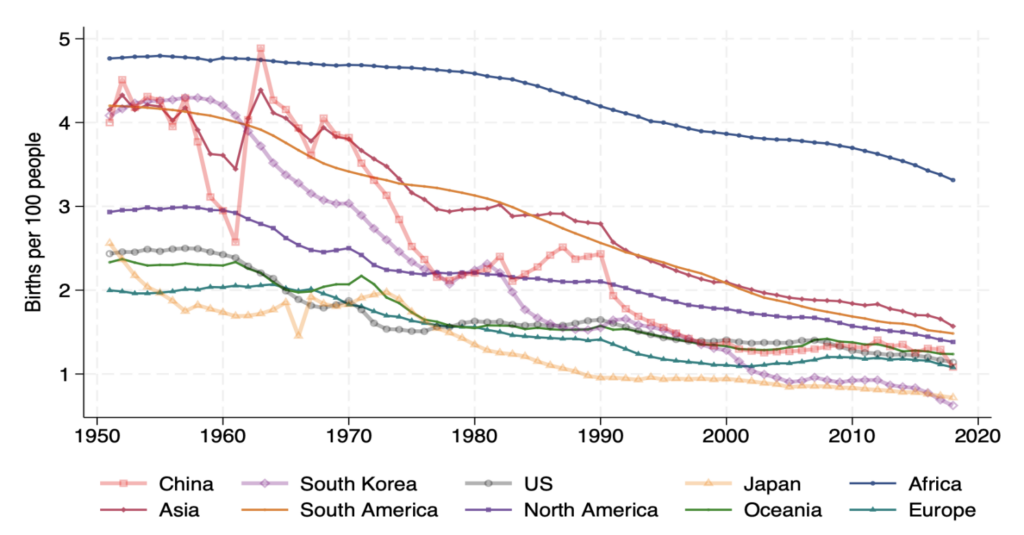
Data from UN Population Prospects 2024 (Source: Figure 1, Acemoglu et al.)
Economists and policymakers often express concern that declining birth rates will slow economic growth. Older workers are assumed to be less productive, innovative, entrepreneurial, and technologically adept than younger workers. Shrinking, aging populations are expected to generate less consumer spending and investment and fewer workers, while simultaneously increasing pension and healthcare costs.
While these concerns are often forward-looking, evidence from the past 70 years of falling birth rates can inform our predictions. New findings from Acemoglu and co-authors challenge conventional wisdom: lower birth rates have not hampered economic growth, and in fact have increased productivity per worker.
Finding #1: Lower birth rates increased productivity per worker, without hurting economic output
Lower birth rates, and the aging and shrinking populations that follow, have raised GDP per worker since 1950, not lowered it. Across countries, a one percentage point lower birth rate is associated with an approximately 22% higher GDP per worker2 40 years later, and 29% higher 60 years later. Within the US, regions with lower birth rates have experienced significantly faster average wage growth.3
These gains in productivity per worker were large enough to fully offset the reduction in total output resulting from fewer workers. Total economic output and overall earnings were unaffected. This evidence goes against standard models of economic growth, which predict that lower birth rates will cause an overall decline in GDP.
Finding #2: Labor scarcity causes firms to invest in technology, increasing productivity
Why do declining birth rates result in faster economic growth? The main driver is that when labor becomes more scarce, companies develop and adopt labor-saving technology. These investments in technology make each worker more productive and increase wages on average.
Countries with lower birth rates shift exports toward high-tech industries, and see significantly faster growth in total factor productivity (a measure of how efficiently an economy uses its labor and capital to produce goods). Similarly, in the US, areas with lower birth rates shift employment away from labor-intensive industries and toward R&D-intensive industries. These areas also see an increase in the share of patents that reduce the need for workers, such as IT and automation technology.
The data do not support other conventional potential explanations for the relationship between lower birth rates and higher productivity per worker. For example, there is no evidence that lower birth rates bring more women into the workforce, nor that fewer births leads to more investment per child through higher-quality childrearing or more resources per student in schools. The hypothesis that lower birth rates spur transitions from agriculture to manufacturing, increasing productivity per worker, is also unsupported.
Finding #3: Scarcity of younger workers – rather than scarcity of population – drives these results
Are these increases in productivity driven by the fact that the population is smaller, or that the workforce is older? To separate these two factors, the researchers analyze the impacts of civilian versus military deaths during WWII across countries. Because the war affected countries differently for reasons unrelated to their economies, it provides a sobering natural experiment. Civilian deaths reduced population size without fundamentally changing the age structure, whereas military deaths were concentrated among young men, shrinking the population and raising the average age of the workforce.
Across countries, more military deaths are associated with higher future GDP per capita, while civilian deaths correspond with lower GDP per capita. This suggests that it is specifically a scarcity of younger workers that prompts companies to adopt labor-saving technologies. These technological shifts then increase productivity per worker.
Conclusion: Smaller, older populations do not inevitably shrink the economy
These findings challenge traditional economic models, which predict that lower birth rates lead to declines in overall GDP, and that increases in productivity per worker do not persist. However, many countries are on the cusp of even more significant (and faster) population changes. For example, China’s working-age population is expected to fall from its peak of 1 billion to around 300 million by 2100. China leads the world in the development and adoption of robotics, but will these investments be enough to counteract the economic impacts of a declining population in the coming decades?
The future is far from pre-ordained. Life expectancy is rising along with these demographic shifts, which could bring about other institutional changes, policies, and investments. And technology and investment responses in the age of artificial intelligence may differ from decades past. The past 70 years make clear that the future of global economies will depend not only on demographic changes, but on our technology and policy choices in an era of rapid technological transformation.
Source: Daron Acemoglu, David Autor, Keelan Beirne, and Andrew Scott, “Baby Busts and Growth Booms: Demographic Change and the Macroeconomy,” NBER Working Paper 35401 (2026), https://doi.org/10.3386/w35401
We gratefully acknowledge support from the James M. and Cathleen D. Stone Foundation and the William and Flora Hewlett Foundation.
- The researchers analyze data from US commuting zones, which represent local labor markets. Back
- “GDP per worker” is used as shorthand for GDP per working-age (20-70) adult. Back
- The researchers analyze composition-adjusted wages, which hold worker age, education, gender and race fixed to ensure that shifts do not reflect changes in who is working. Back