The US tax system is biased against workers in favor of machines and algorithms, and has become more so in recent years. Leveling the playing field in the tax code is a necessary step to preserve jobs in the age of AI.
There is widespread concern that AI will replace workers in many job tasks, resulting in significant job loss. US policymakers have proposed various policies to mitigate these effects, including taxing AI developers and taxing companies that replace workers with AI. But we are not starting from a blank slate. The US tax code currently incentivizes companies to deploy machines and algorithms over hiring workers, and this has become more pronounced in recent years.
Daron Acemoglu, Andrea Manera and Pascual Restrepo identify and quantify this bias in a 2020 paper, published in Brookings Papers on Economic Activity. They calculate the effective tax rates on labor and capital1 in the US since 1980. They also develop a model to determine the optimal tax rates, including considering an automation tax. They argue that the tax code’s bias has led companies to automate work even when machines have little to no comparative advantage over human workers.
Labor is taxed at 25% or more, while machines are taxed at 5%
The effective tax on labor in the US today is 25.5%. This includes personal income taxes, payroll taxes, and benefits like employers’ contributions to pensions and health insurance. If means-tested programs like cash transfers, credits, disability and unemployment insurance are also included as an “implicit tax” on labor, this raises the effective tax to 33.5%.
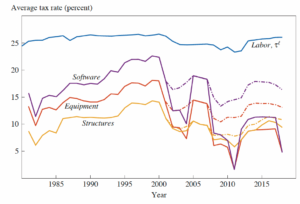
In contrast, the effective tax on software and equipment is 5%. This includes personal taxes on capital income, corporate income taxes, depreciation allowances, and interest rate deductions. This effective tax has declined considerably over time, falling from approximately 20% in 2000, to 10% in the 2010s, to 5% after the reforms in the 2017 Tax Cuts and Jobs Act.
About half of this decline is due to changes in depreciation allowances, specifically to the “bonus depreciation” rate. In 2017, the federal bonus depreciation rate was raised from 50% to 100%. This meant that firms could write off 100% of their investment in certain types of capital – including all software and equipment – in the first year. Although the bonus depreciation rate began to wind down after 2023, in 2025 it was raised again permanently to 100%.
Figure 1 shows how effective taxes on capital and labor have changed over time. The dashed lines show what the effective taxes on capital would be without the depreciation allowance reforms since 2000. Changes to depreciation allowances are also the reason why structures are taxed at relatively higher rates than software and equipment today, whereas in the past they were taxed less.
Figure 1: Effective Tax Rates on Labor, Software, Equipment, and Nonresidential Structures
Source: Figure 1, Acemoglu et al.
The lopsided tax treatment of capital and labor has led to excessive automation
The researchers’ model defines optimal tax rates on labor and capital as those that maximize households’ well-being while generating a fixed amount of revenue for the government. Based on their model, the optimal rates would be a 18.22% tax on labor and a 26.65% tax on capital. Moving to this optimal system from the current system would raise employment by 4% and increase the labor share by 0.78 percentage points.
In contrast, the current tax system incentivizes companies to invest in software, equipment, and algorithms over hiring workers. As a result, employment levels are artificially low and tasks are automated excessively, even when humans have a comparative advantage in them.
Within this system, imposing an automation tax is socially beneficial. An optimal automation tax would not discourage the use of algorithms or machines in tasks where machines have a strong comparative advantage. Instead, it would disincentivize “so-so automation,” or automation that displaces workers without significantly improving productivity. The researchers calculate that the optimal level for an automation tax is 10.15%. Under this tax, firms would only automate a task if replacing a worker with a machine reduces the cost of producing the task by more than 10.15%. This automation tax, applied within the current tax system, would raise employment by 1.14% and increase the labor share by 1.93 percentage points.
Reducing taxes on capital is not the best way to stimulate employment
Many of the tax reforms since 2000 were intended to stimulate the economy and increase employment. They did increase employment by reducing effective taxes, but they did so at a large cost to the government per job created, largely because they encouraged additional automation. For example, the researchers estimate that the tax cuts on capital between 2000 and the mid-2010s reduced government revenue by 10.49% while increasing employment by only 1.01%. This means that every job created cost the government over $162,000.
Reducing labor taxes or combining lower capital taxes with an automation tax are much more efficient ways to create jobs. Reducing labor taxes to 21.09% (e.g., through a payroll tax cut) while keeping the effective tax on capital at 20% would have increased employment by 3.56% and cost the same amount of government revenue, less than $46,000 per job created. This policy is so much more effective partly because it would have reduced automation, which was already excessive. Alternatively, combining lower capital taxes (8.58%) with an automation tax of 11.42% would have increased employment by 2.43% and cost only $67,000 per job created.
Excessive automation crowds out pro-worker innovation
Incentivizing automation also has upstream effects on technological development. Developers are incentivized to produce technology that they expect will be adopted. Excessive demand for automating technology crowds out other types of innovation, such as pro-worker technology.
The current path of AI is heavily focused on automation and the pursuit of “artificial general intelligence,” with the explicit goal of replacing humans in many tasks. This focus of AI development is not inherent to the technology, but is rather shaped by the vision of industry leaders. Correcting the tax code’s bias against labor is not the only reform needed to redirect the path of AI, but it is key to changing the incentives that help keep this vision dominant.
Source: Daron Acemoglu, Andrea Manera, and Pascual Restrepo, “Does the US Tax Code Favor Automation?” Brookings Papers on Economic Activity (2020), https://www.brookings.edu/wp-content/uploads/2020/12/Acemoglu-FINAL-WEB.pdf
We gratefully acknowledge support from the James M. and Cathleen D. Stone Foundation and the William and Flora Hewlett Foundation.
- Capital includes structures (nonresidential buildings and infrastructure like plumbing and heating), equipment, software, algorithms, and computing infrastructure. Back