

An audience member asks a question at the Stone Center symposium. Credit: Bryce Vickmark.
On January 27, 2026, the James M. and Cathleen D. Stone Center on Inequality and Shaping the Future of Work hosted a half-day symposium at MIT on “Why Wealth Inequality Matters.”
Three panel discussions convened experts from economics, philosophy, sociology, and political science to explore the origins, mechanisms, and political consequences of wealth inequality.
Richard Locke, John C Head III Dean of the MIT Sloan School of Management, welcomed attendees to the symposium, emphasizing how the event reflects MIT’s commitments to interdisciplinary collaboration and to addressing “society’s most pressing issues.”
Here are three key takeaways from the afternoon’s panels.
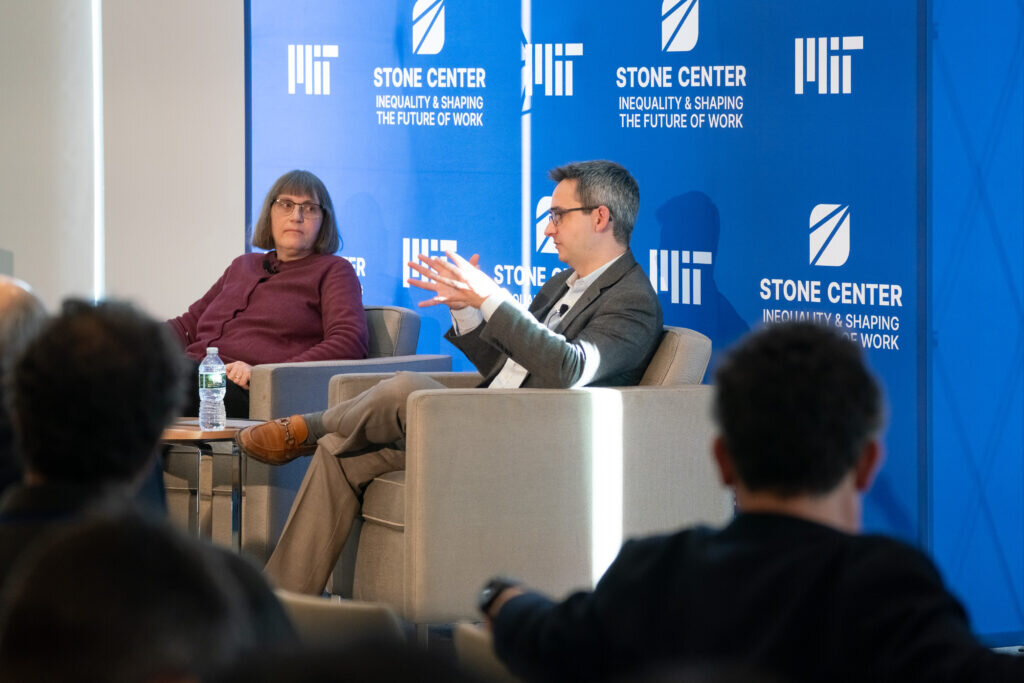
Left to right: Elizabeth Anderson and Oren Cass speak on a panel at the Stone Center symposium. Credit: Bryce Vickmark.
When wealth buys political influence and legal immunity, democracy is threatened
Hélène Landemore of Yale University argued that wealth inequality isn’t inherently problematic, but becomes dangerous when wealth offers disproportionate influence in other spheres, including political power.
Wojciech Kopczuk of Columbia University echoed this, emphasizing that wealth is a complicated and often ambiguous measure of inequality. Wealth reflects institutional contexts – for example, weak safety nets drive precautionary saving. Still, he agreed that wealth is a relevant metric at the very top, where it correlates with political capture and corporate power.
Landemore explained that when the wealthy dominate policy discussions, “some groups are systematically disbelieved or ignored, and the result is policy failure.” For example, French carbon taxes disproportionately burdened working-class people who were more dependent on cars, which led to the yellow vests protests.
Elizabeth Anderson of the University of Michigan extended this point to corporate power, warning that extreme concentration gives powerful firms de facto immunity from the rule of law – the wealthiest companies can hire hundreds of lawyers to swamp the legal system.
To counteract these negative consequences of high inequality, Oren Cass of American Compass argued that strengthening worker power is key. Redistribution, he said, is a way to improve living standards, but “it is not a solution to the kinds of problems that actually plague democratic capitalism.”
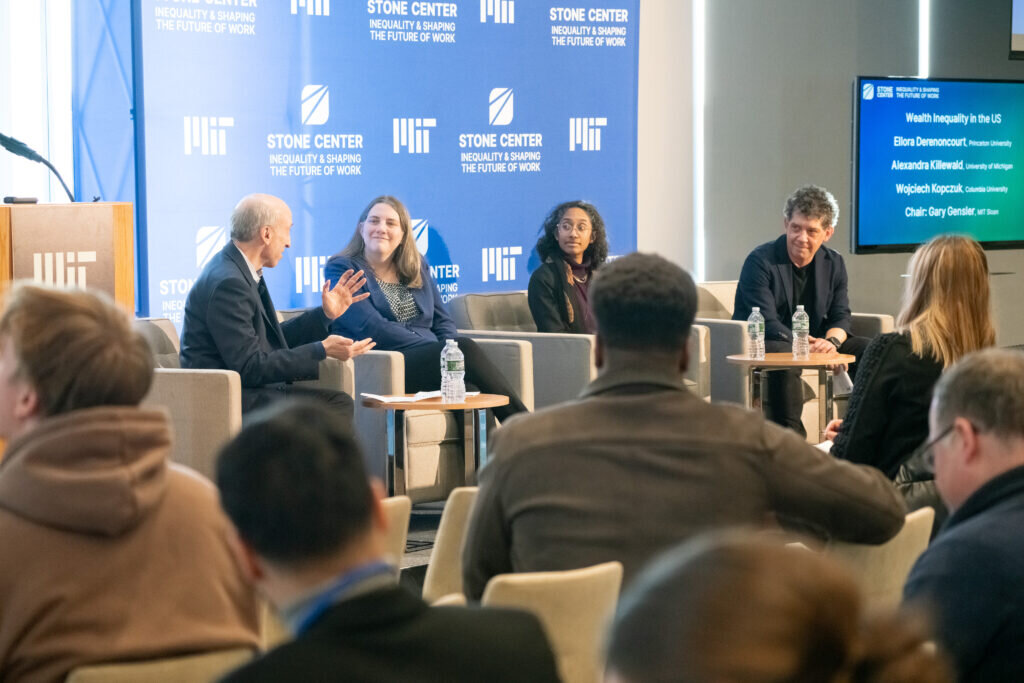
Left to right: Gary Gensler, Alexandra Killewald, Ellora Derenoncourt, and Wojciech Kopczuk speak on a panel at the Stone Center symposium. Credit: Bryce Vickmark.
The roots of the racial wealth gap are so deep that equal opportunity alone won’t close it
Ellora Derenoncourt of Princeton University explained that in the US today, the wealth gap between Black and white Americans is 6:1. In other words, for every dollar of wealth held by an average white American, the average Black American holds about $0.17. She noted that this racial wealth gap has largely remained unchanged for the past 50 years.
“Even if we were to equalize differences in wealth accumulating opportunities — equal savings rates, equal capital gains rates going forward — we’re still hundreds of years away from convergence,” she explained, due to the magnitude of the original gap.
Alexandra Killewald of the University of Michigan added that the racial wealth gap is actively rebuilt each generation through unequal schools, unequal pay, and unequal access to homeownership.
“The past matters, but it’s not just about the past,” she explained. Even if a massive reparations plan were implemented, “if we just let things go on as they are, we will start to recreate inequality from day one.”

David Yang presents at the Stone Center symposium. Credit: Bryce Vickmark.
High inequality and authoritarianism reinforce each other
Daron Acemoglu of MIT described how increasing inequality goes hand-in-hand with the weakening of democracy: “Once inequality starts building up, it also naturally erodes democracies’ claim for legitimacy.”
High inequality, he argued, is both a cause and an effect of liberal democracy failing to deliver on its promise of shared prosperity. This failure, in turn, weakens public support for democracy.
Building on this argument, Sheri Berman of Barnard College examined why economically disadvantaged voters in the US and Europe have increasingly voted for right-wing populist parties, despite holding economically progressive views.
She described how center-left parties have transformed since the late twentieth century, converging with the right on economic policy (embracing free trade and market deregulation) while moving left on social and cultural issues. As a result, she argued, working-class and rural voters no longer saw center-left parties as champions of their economic interests, or as reflecting their social and cultural preferences.
David Yang of Harvard University explained that once authoritarianism takes hold, regimes continue to produce inequality. For example, non-democratic regimes are most responsive not to the average citizen, but to whoever poses the greatest threat to regime survival. In China, this tends to be the wealthier urban population capable of organizing large-scale collective action.
—