When power looms automated weaving in early 19th-century Britain, profits and output in the cotton industry boomed – but weavers’ wages collapsed and stayed low for decades. New technologies do not automatically benefit workers, even when they increase total productivity.
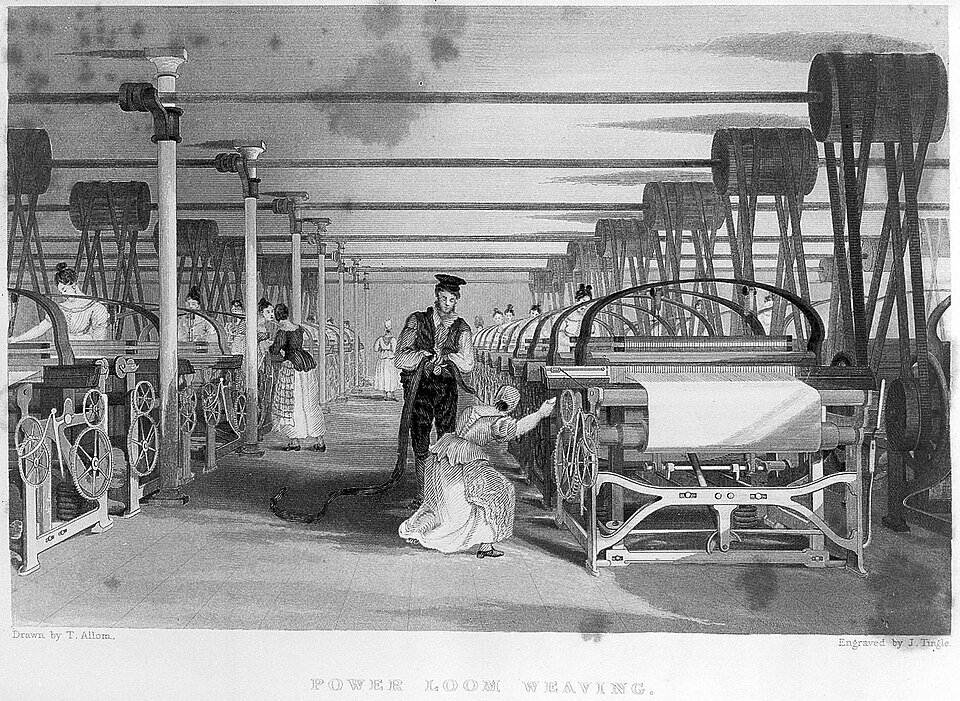
Source: Wellcome Collection, CC BY 4.0
Conventional wisdom in economics says that all technological advances which increase total productivity will ultimately benefit workers, at least on average. Technology – even automating technology – is often understood as a rising tide that lifts all boats.
However, research by Daron Acemoglu and Simon Johnson, published in the Annual Review of Economics, studies the case of weavers in the early Industrial Revolution to show that this assumption does not always hold.
In early industrial Britain, productivity surged in the cotton industry first with the mechanization of spinning and then with the invention of the power loom. Weavers benefited when the price of spun cotton declined, but when factory-based weaving machines became dominant, the wages and working conditions for handloom weavers deteriorated. The influential early 19th-century economist David Ricardo initially believed machines would necessarily benefit workers, but changed his mind after witnessing firsthand the collapse of weavers’ wages and living standards.
The British economy boomed in the early Industrial Revolution, but workers did not reap the benefits
The British cotton industry grew massively between 1780-1820, initially driven by the mechanization of spinning, which turned raw cotton into yarn. By 1813, cotton made up at least 7% of Britain’s GDP, compared with 1% in the early 1780s. Total British exports more than tripled during this period, with cotton accounting for 42% of the value of total exports in the mid-1810s. The cotton industry was one of the first to widely introduce machines in factories.
The ability to spin cotton more efficiently into yarn increased demand for weavers, who turned the yarn into fabric. In the late 1700s and early 1800s, fabric was produced by handloom weavers who worked out of their homes or small workshops. The profession was relatively well-paid, and workers had independence and autonomy over their schedules.
But between 1800 and 1820, the power loom spread throughout Britain, automating the work of weaving. As a result, wages for handloom weavers collapsed. Figure 1 shows the steep drop in handloom weaver wages in the early 1800s. Handloom weavers had previously earned twice as much as factory workers. By 1820, they earned 25% less.
Figure 1: Wages of Handloom Weavers vs. Cotton Factory Workers, 1806-1846
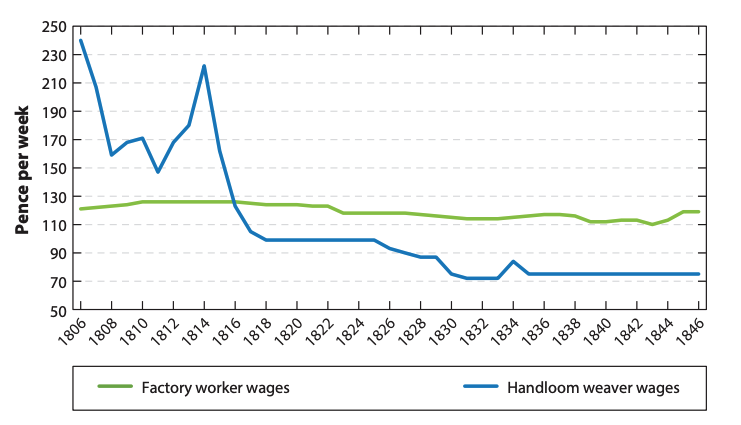
This figure shows handloom weaver and factory worker nominal wages (actual wages received, not adjusted for inflation or purchasing power) from 1806-1846. Handloom weavers earned roughly twice as much as factory workers in 1806. By 1820, handloom weavers earned 25% less than factory workers, and their wages continued to decrease over time. Factory workers include spinners and weavers. Nominal wage data is from Wood (1910e). (Source: Figure 1, Acemoglu & Johnson 2024)
The real wages of handloom weavers – wages adjusted for inflation and purchasing power – dropped to about a quarter of their peak level, and then continued to decline. Despite this collapse in earnings, hundreds of thousands of handloom weavers remained in the profession and struggled to survive.
Why didn’t they move into other occupations? There is evidence to suggest that handloom weavers resisted better-paying factory jobs because of the extremely poor working conditions and lack of autonomy. In addition, for at least the first two decades of the 19th century, cotton factories did not grow fast enough to employ many handloom weavers. There was no other booming sector in the British economy in which to find work, especially in Lancashire, where many handloom weavers lived. The main complementary activity to weaving – spinning – was already mechanized. Some new jobs were created (e.g., repairing the power looms), but not enough to compensate for the handloom weavers who were displaced by machines.
In 1820, there were still double the number of handloom weavers in Britain as there were factory workers. As Figure 2 shows, it wasn’t until other types of factory work expanded in the 1820s that factory employment took off.
Figure 2: Employment of Handloom Weavers vs. Cotton Factory Workers, 1806-1846
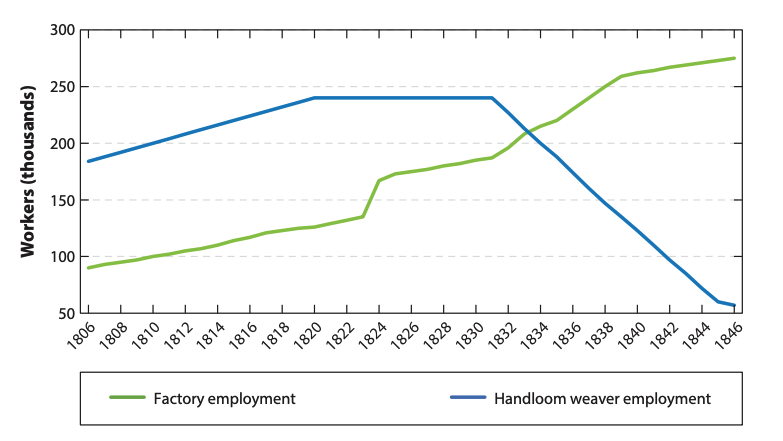
This figure shows handloom weaver and factory worker employment in Britain from 1806-1846. Factory workers include spinners and weavers. Factory worker employment begins to increase more dramatically in the early 1820s, but handloom weaver employment does not decrease until the 1830s. There are more handloom weavers than factory workers until 1833. Employment data are from Wood (1910e). (Source: Figure 4, Acemoglu & Johnson 2024)
Real wages for all workers in the British economy largely remained flat from the late 1700s into the 1820s. In fact, real wages declined sharply in the sectors with the most notable productivity gains, including the cotton industry. While entrepreneurs and factory owners made huge profits from the mechanization of weaving, workers did not share in the gains.
In addition, working conditions and quality of life for workers deteriorated with the arrival of the power loom and the growth of factories. Factory workers not only had little autonomy, but were forced to work in unsafe conditions and live in unsanitary housing. Crucially, workers did not have the legal right to bargain collectively or the political voice to advocate for higher wages and better working conditions. The historian E.P. Thompson argued that the factory system fundamentally shifted power away from workers, and that this power imbalance was critical to determining who benefited from new technology.
New technologies can increase workers’ wages, but only when they create new tasks or new demand in complementary sectors – and when workers have sufficient power
As the case of handloom weavers illustrates, workers do not automatically benefit from new technology. Technologies that automate work can reduce the demand for labor. Unless the technology also creates new tasks for workers to perform, or spurs growth in related industries, wages are likely to decline. Even if these conditions are met, workers are unlikely to benefit from new technology unless they have enough power and political voice to push for their share of the productivity gains.
Today, AI may increase average productivity, but there is no guarantee that these gains will be shared with workers. Previous waves of automation since 1980 have brought down real wages for affected workers. If used mainly to automate work, AI could replace many workers and worsen job quality for others (e.g., through surveillance). However, if AI is used to create new tasks for workers and complement their capabilities, it is more likely that workers will share in the benefits. Even in this latter scenario, history teaches us that workers will need adequate political and bargaining power to secure their share of the gains from AI.
Source: Daron Acemoglu and Simon Johnson, “Learning From Ricardo and Thompson: Machinery and Labor in the Early Industrial Revolution and in the Age of Artificial Intelligence,” Annual Review of Economics (2024), https://doi.org/10.1146/annurev-economics-091823-025129
We gratefully acknowledge support from the James M. and Cathleen D. Stone Foundation and the Hewlett Foundation.